
← Back to articles · Hobby & visiting shops ·
Why coin value apps and Google “worth” searches lie to you
Coin price apps, Google results, Etsy asking prices, and YouTube “found in a jar” videos are not cash bids. Here is how the fantasy pipeline works — and how to check what you actually have.
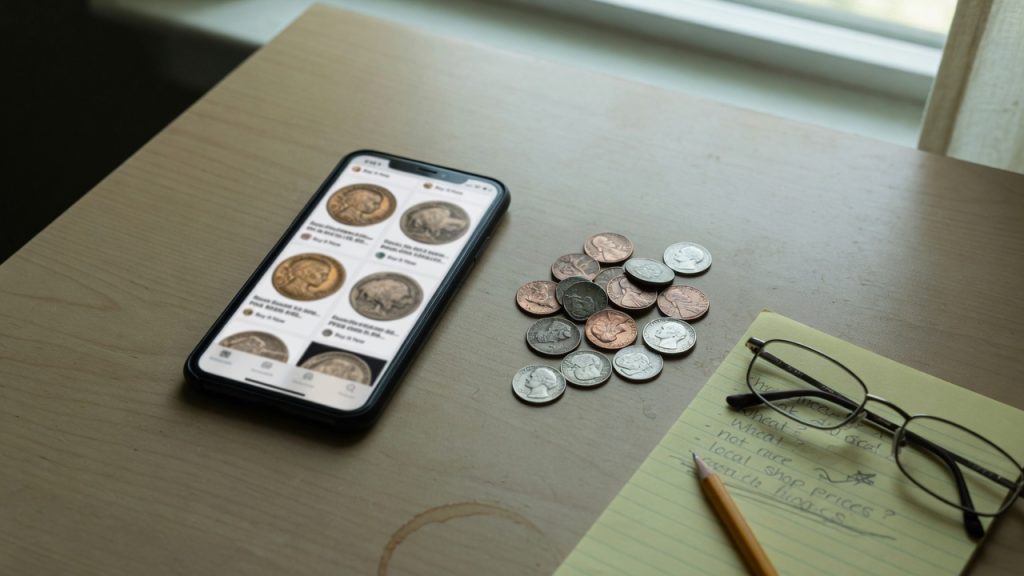
If you have a coin jar, a purse full of foreign leftovers, or a cereal box of “old pennies,” the internet will happily tell you that you are sitting on a fortune. A free app will slap a dollar figure on a blurry photo. Google will surface Etsy and eBay asking prices. YouTube — owned by Google — will autoplay a creator explaining that the wheat cent in your change jar is “worth hundreds if not thousands.”
Then you walk into a real shop. The offer is small. You feel robbed. You leave a one-star review. The dealer shrugs and goes back to weighing scrap gold, because this movie plays every week.
This guide is the boring, useful version of that story. No conspiracy. No “dealers hate this one trick.” Just how the fantasy price pipeline works — and how to step out of it before you waste a Saturday.
The four-layer fantasy machine
1. Coin value apps
Phone apps that “identify and value” coins are built for engagement, not for writing a check. Typical problems:
- They match a photo to a catalog type, not to your coin. Lighting, wear, cleaning, scratches, holes, and post-mint damage do not survive a cheap camera pass. The app still returns a confident number.
- They often show retail or “up to” guide numbers. Those are closer to what a collector might pay for a choice example — not what a shop pays cash same-day for a raw, average piece.
- They cannot see the market you are actually in. A rare date in gem condition sells in a different room than a worn common date with the same year stamped on it.
- They never have to buy the coin. An app has no inventory risk. A dealer who overpays goes broke. That incentive difference is the whole game.
Apps can be fine as a rough sorting tool (“is this a wheat cent or a modern Memorial?”). They are terrible as a price tag you take to the counter like a receipt.
2. Google searches for “how much is my coin worth”
Google’s job is to rank pages people click. The pages that win are often:
- Marketplaces with high asking prices (Etsy, eBay Buy It Now, Facebook Marketplace)
- SEO blogs that repackage “rare error!” lists for ad revenue
- Video results that reward shock thumbnails and dramatic voiceovers
What ranks less well, on purpose, is a dry sentence like: “Your 1964 Kennedy half is common 90% silver; pay is based on melt and condition, not the viral listing of a perfect proof set.” Dry truth does not earn ad clicks. Fantasy does.
So when you type a date and mint mark, you are not pulling a live bid book. You are pulling a mix of hopeful sellers, content farms, and entertainment. Treat it like that.
3. Etsy (and similar) asking prices
Etsy is a craft and vintage marketplace. People can list a common wheat cent for $49.99 with a story about “estate find” and “possible rare variety.” Nobody is forced to buy it. Listings can sit for years. Google still shows that $49.99 when someone searches the date.
That is not a market price. That is a wish. Real markets show sold results for comparable condition — and even then, auction results for slabs are not cash bids for raw coffee-can coins.
If the only “comps” you have are unsold Etsy asks, you do not have comps. You have window shopping.
4. YouTube and short-form “coin jar” videos
YouTube is an attention business. The algorithm rewards:
- Thumbnails with shocked faces and giant dollar signs
- Titles that imply your jar or purse is a lottery ticket
- Rapid cuts through dozens of dates so every viewer “might” have one
- Vague language: “could be worth,” “up to,” “in the right grade,” “if it’s the rare variety”
Google owns YouTube. Search and watch recommendations naturally surface more of the same family of content. That is not a secret cabal against coin shops. It is self-reinforcing entertainment. Shock content about “worth thousands” keeps people on the platform. Patient education about melt value and common dates does not.
Any coin that ever sat in a jar, a purse, a glove box, or Grandma’s button tin can get a listing and a video. That does not make it rare. It makes it content.
Creators are not writing you a buy offer. They are earning watch time. Some of them are careful and honest. Plenty are not. The platform does not care which, as long as you stay.
What “worth” actually means (four different numbers)
Most fights at the counter come from mixing these up:
- Asking price — what a hopeful seller typed into a listing. Often fiction.
- Guide / app / Red Book line — a reference range for retail or catalog context. Not a cash bid. See also: The Red Book is not a dealer buy-price guide.
- Sold auction / slab result — what someone paid for a specific graded piece after fees and time. Useful context; still not your raw coin.
- Dealer cash bid today — what a shop will pay now, with risk, rent, and resale room baked in. This is the only number that clears your table today.
When an app or video says “worth $800,” ask: worth to whom, in what condition, in what venue, after what fees, and has it actually sold? If nobody answers those, the number is decoration.
The jar / purse / glove-box test
Here is a hard rule that saves feelings:
- If it lived in pocket change for years, it is usually common and worn.
- If it is a modern clad coin (most U.S. after 1964/1965 for silver, except special bullion), metal value is near face.
- If every video about that date starts with “most are common, but…” — assume yours is the common one until proven otherwise.
- Rare varieties are rare because almost nobody has them — not because the algorithm found one for every subscriber.
Yes, people still find treasures. No, the algorithm is not a metal detector for your specific jar.
A sane research workflow (15 minutes, no rage)
- Identify the type — date, mint mark, denomination. A loupe helps. An app can help here; stop using it for money.
- Separate melt from collector — pre-1965 U.S. silver has metal value; most modern clad does not. Gold jewelry and tiny “coin” charms are often use-gold, not investment bullion (see tiny gold coins & use gold).
- Look at sold comps in the same condition — not “Buy It Now” asks, not Etsy wish lists.
- Check a real guide for context — Red Book or a serious site for “is this a key date?” not for a cash number.
- Get a live bid — a local shop or two. Compare same-day. Use CDXList.com to find dealers near you.
Why shops will not “match the video”
A shop cannot pay YouTube numbers for common material and stay open. They pay:
- Melt-based spreads on scrap and junk silver
- Wholesale-ish bids on common collector coins they must resell
- Closer-to-retail only when a piece is desirable, authentic, and easy to place
That is not theft. That is a business. If you want retail, you become the retailer: photos, fees, shipping, returns, time, and the risk of no sale. Many people decide the cash bid is worth the convenience. That is a valid choice — when you understand it.
How to talk about this without starting a fight
At the counter, try:
- “I saw high numbers online — can you walk me through what mine actually is?”
- “Is this melt, common collector, or something better?”
- “What would change the bid — better grade, key date, original surfaces?”
Avoid: “The app says eight hundred” as if the phone is the bank. Good shops will still explain. Bad shops will dismiss you. Either way, you learn more with a question than with a confrontation.
Bottom line
Coin apps, Google “worth” results, Etsy asks, and jar-treasure YouTube are entertainment and lead generation. A dealer bid is a price. Learn the difference and the counter stops feeling like a conspiracy.
Keep reading: why the offer was less than you expected, how shops price metal and coins, tiny gold coins, use gold, and 10k/14k novelties, and what to expect on a first visit. Find local dealers on CDXList or via NumisQ Shops.
Related: age is not value — start with old is not rare and the type-by-type series (cents, nickels, dimes/quarters, halves/dollars, ancient/world).
Melt is one honest number: the metal at spot. Melt Prices figures that. It is still not a shop bid. Melt before you visit.