
← Back to articles · Hobby & visiting shops ·
Twenty-cent pieces: the short-lived coin people still call a quarter
The twenty-cent piece (1875–1878) is 90% silver and almost the size of a quarter. 1875-S is the common date. 1876-CC is a famous rarity. 1877 and 1878 are proof-only. If it says TWENTY CENTS it is not a quarter.
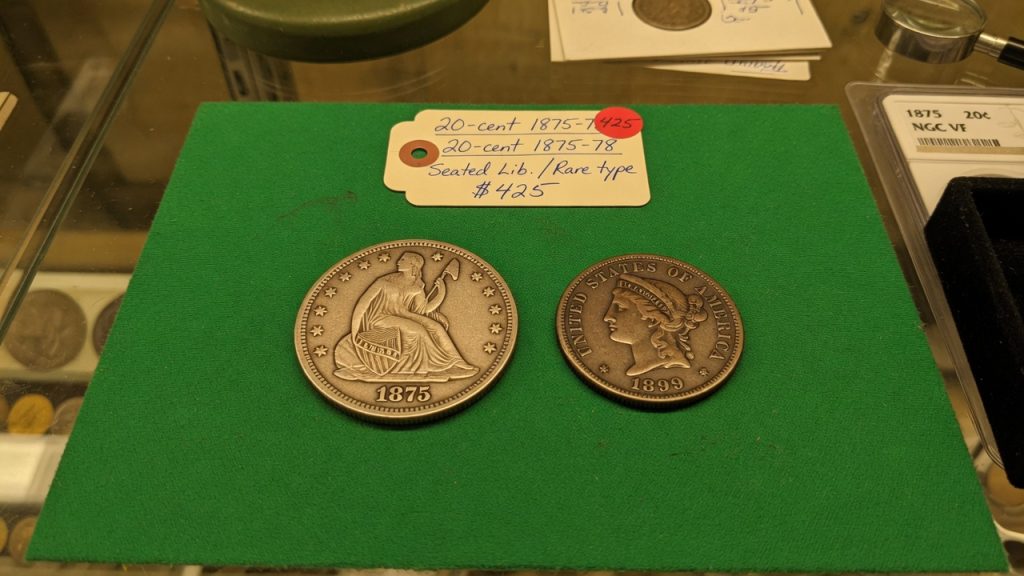
A twenty-cent piece is a US silver coin struck for circulation in 1875 and 1876, with proofs 1877–1878. Seated Liberty look, close to a quarter in size. The reverse says TWENTY CENTS. That is the tell. What face value means.
People spent them as quarters and hated them. The series died.
Common vs the ones we pull
1875-S is the one in drawers. 1875 Philadelphia and 1875-CC are scarcer. 1876 is low. 1876-CC is a famous rarity (most melted). 1877 and 1878 are proof-only. If someone has a coffee-can 1876-CC, we are very slow and very skeptical. How shops check authenticity.
Extra history
The West wanted a coin for a bit of a dollar that was not a quarter. Congress created a nearly-quarter. Same Seated family as the dime and half dime. Same lesson as the SBA a century later: if it feels like a quarter, people will spend it as one.
What a shop pays
1875-S worn: a type bid over melt. Others: we look them up. Don’t clean. 90% silver.
People also ask
Is it a quarter? No. Twenty cents.
Is 1875-S rare? No. It is the common date of a scarce type.
Are they 90%? Yes.
Part of the coin and money library · visitors & collectors
The reverse eagle on a twenty-cent faces the other way from a quarter of the same era — another tell besides TWENTY CENTS. In a worn pocket piece the words go first, which is why heirs call them quarters.
Do not clean the gray film hoping the words come back. Don’t clean.
Same drawer as Trade dollars and leftover Seated coins: 1870s silver that is not a Morgan.
Same seated family: Seated Liberty coins.