
← Back to articles · Hobby & visiting shops ·
Susan B. Anthony dollars: the small dollar people spent as quarters
Susan B. Anthony dollars (1979–1981 and 1999) are copper-nickel clad, not silver. They are about the size of a quarter with an 11-sided rim. The 1979-P near date is a variety. They are not Ike dollars and not Sacagawea dollars.
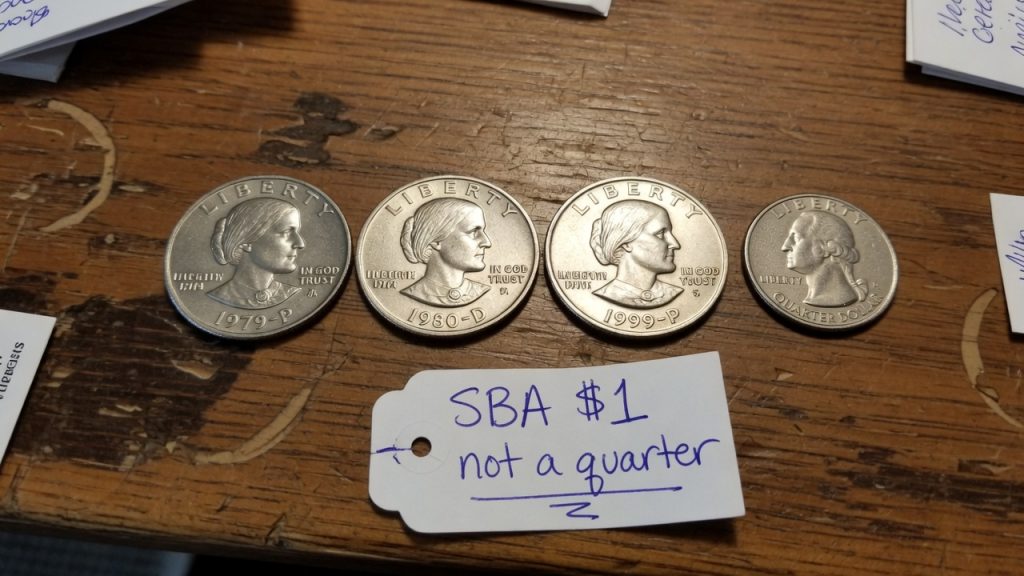
A Susan B. Anthony dollar is the small $1 coin struck 1979, 1980, 1981, and again in 1999. Clad. Not silver. The rim is reeded and looks eleven-sided. People mixed them with Washington quarters in the dark. That is why the later Sacagawea is gold-colored. Eisenhower dollars are the large dollar next to them.
Near date and mint marks
1979-P near date (wide rim) is the collected variety — the date sits closer to the rim. Regular 1979-P is common. Mint mark is on the obverse, near the shoulder.
1981 coins were made for collectors more than for change. 1999 was struck because the Postal Service and transit still needed a small dollar before the Sacagawea arrived.
What a shop pays
Most SBA dollars: face, or a little over for a roll of problem-free 1979s. Near-date 1979-P: a nod. Proofs in original cases follow proof set vs mint set. What face value means.
Extra history
Congress wanted Ike’s dollar to circulate. It was too big. They shrank it and put Anthony on it — first circulating US coin with a real (non-allegorical) woman. The size was still a quarter in the hand. Modern dollars.
People also ask
Is an SBA silver? No.
Is it a half dollar? No. It says ONE DOLLAR.
Is 1999 rare? No. It is the late return, not a key.
More on the coin and money library.
A register drawer of “odd quarters” is often SBAs. Look at the reverse: eagle landing on the moon (same Apollo family as the Ike) and ONE DOLLAR. A quarter says QUARTER DOLLAR.
1999-P and 1999-D exist. They are late, not rare. Proof 1999-P is a collector strike.
If the same box has Ike dollars, two stacks: large and small. Then clad vs 40% on the Ikes only.
Live melt (clad, not silver): SBA dollar. Not a Sacagawea. Not gold.