
← Back to articles · Hobby & visiting shops ·
National bank notes: the town name on a US dollar
National bank notes (1860s–1935) are US currency issued through a local national bank. They have a charter number and usually the town name. They are not obsolete broken-bank notes and not Confederate notes. Common large-size types are collected; rare banks are a specialist look.
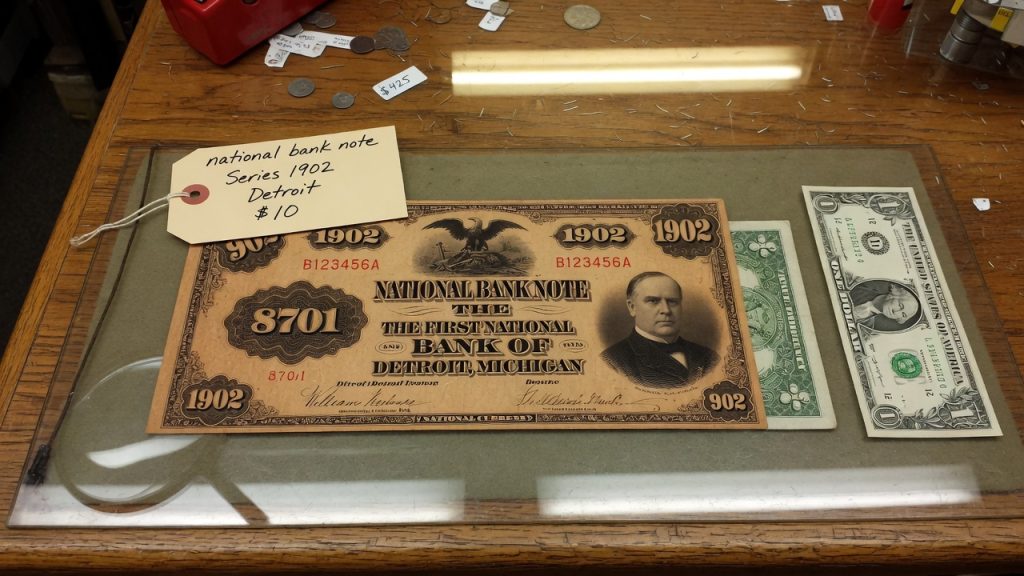
A national bank note is a United States note issued through a chartered national bank. 1863 through 1935. It says National Bank or National Currency. It has a charter number. It often names a town. That is the whole idea: the government’s paper, the local bank’s name. What a banknote is. Greenbacks to Federal Reserve notes.
Large-size (“horse blanket”) and later small-size both exist. Horse blankets.
What this is not
Not an obsolete / broken-bank note — those are private/state banks before this system. Not a Confederate note. Not a gold certificate, even if it looks fancy. If there is a charter number and NATIONAL BANK, start here.
Common vs the ones we pull
Large-size notes from big-city banks in worn grades: a type bid. Small-size 1929 notes: often cheaper. Rare town, low charter, unusual denomination, or a bank that issued almost nothing: specialist money. Condition and signatures matter. We look up the bank; we do not guess from the face value.
Extra history
The National Bank Acts funded the Civil War and replaced the broken-bank chaos with a uniform federal design. Local banks still got their name on the bill. 1935 ended new issues as the Fed took over.
What a shop pays
Common type: a collector note bid over face. Ragged or missing chunks: closer to face. Rare bank: we look it up or send it to someone who lives in that catalog. Don’t clean — do not iron paper.
People also ask
Can I spend it? It is still US currency in the legal sense, but the collector value is the point. Do not buy coffee with a 1902 $10.
Is the town what makes it valuable? Often. A common design from a scarce bank beats a pretty note from a huge bank.
Same as a star note? No. Stars are replacements on later Fed paper.
Continue in the coin and money library. Related visitor guides: for shop visitors.
Write down the town, the bank title, and the charter number before you leave the house. That is what we look up. Face value is the last thing.
Small-size 1929 nationals look more like modern bills. People spend them. Look for the bank name and NATIONAL CURRENCY.
Same estate envelope as obsolete notes and gold certificates: three paper hobbies. Sort by the heading line.