
← Back to articles · Hobby & visiting shops ·
Confederate notes: Southern paper, not US legal tender
Confederate States notes (1861–1864) are Southern wartime paper. They are not US legal tender and they are not “gold.” Common 1864 $5, $10, and $20 notes are collected. Reprints and souvenir copies are everywhere. Sort them from obsolete bank notes and from US greenbacks.
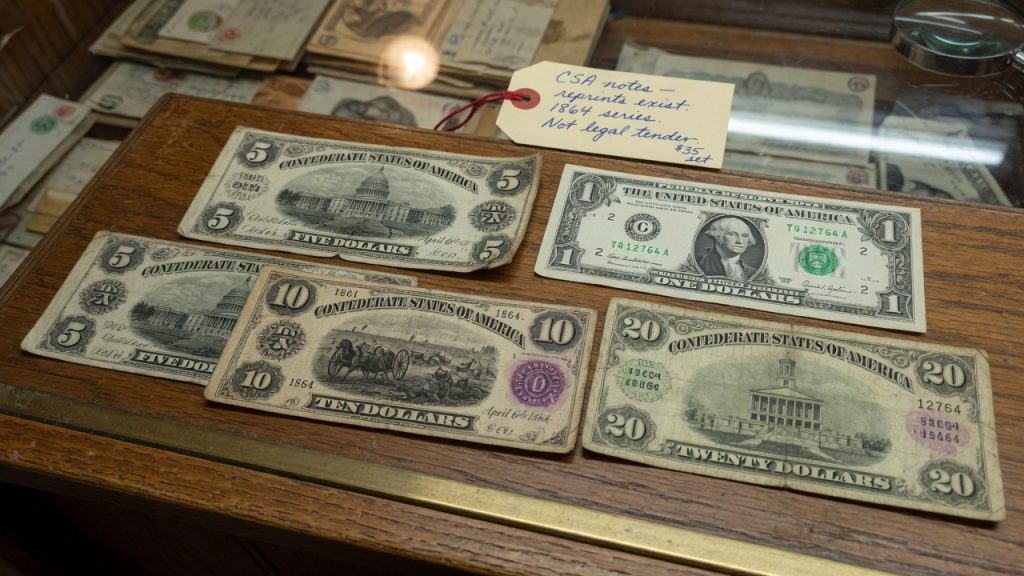
A Confederate note says Confederate States of America. 1861 through 1864. Richmond and the other CSA presses. Collectors use Criswell / Type numbers (T-63, T-68, and so on). They are not United States legal tender. You cannot deposit one. What legal tender means. Emergency money.
Common 1864 $5, $10, $20, and $50 notes (the pink-paper look, the horses and cannon, the Capitol) walk in every other estate. They are collected. They are not a lost Confederate treasury.
Reprints and the other Southern paper
Souvenir reprints, 1960s magazine copies, and modern fakes are common. Real notes have a paper-and-ink look we know; cut-corners “replicas” and bright laser copies do not. We will say so at the counter.
Do not mix these with:
- Obsolete / broken-bank notes — private and state banks, often before the war
- Southern state notes (Alabama, Georgia, and so on)
- US greenbacks and later Federal Reserve notes
Same drawer, three hobbies.
Extra history
The Confederacy printed because it did not have the metal. Inflation ate the notes. That is why a high-face 1864 $500 is not “five hundred dollars” in any living register. Face on a CSA note is a catalog label, not a cash bid. What face value means.
What a shop pays
Common 1864 types in decent paper: a collector type bid. Ragged, taped, or a reprint: little or nothing. Rare early 1861 types and some T-numbers: we look them up. We do not buy a Facebook “uncirculated 1861 $1000” sight-unseen.
Cut-cancelled notes and hole-cancelled notes were often redeemed or cancelled on purpose. That is history, not a defect we hide — it does change the bid. A note that still has the red February 17, 1864 treasury stamp is the late series people actually find.
People also ask
Can a bank cash it? No.
Is it gold-backed? No. It was wartime paper.
Are they illegal to own? No. They are historical paper. Replicas should be marked as copies.