
← Back to articles · Hobby & visiting shops ·
Wheat cent key dates cheat sheet (no prices)
A plain sorting list of early Lincoln / wheat cent dates and mint marks people should set aside — not a price guide. Always check the mint mark under the date.
Use this page to sort a jar, not to name your retirement. Most wheat cents are common. A short list of date + mint combinations deserves a second look. Everything else is usually bulk — see cents: old is not automatically valuable.
This is a sorting aid, not a price list. We do not publish dollar values here. Keys still need correct identification, original surfaces, and a live market bid. Condition can make a “common” date interesting and a “key” date disappointing.
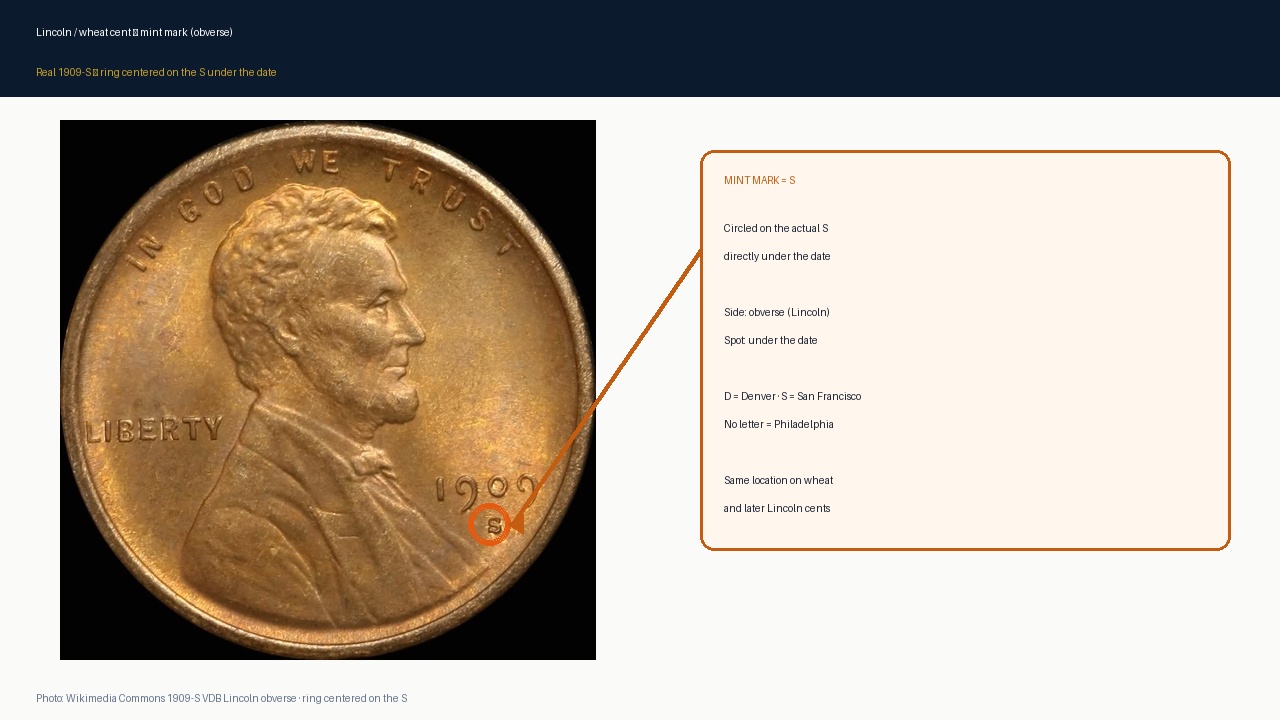
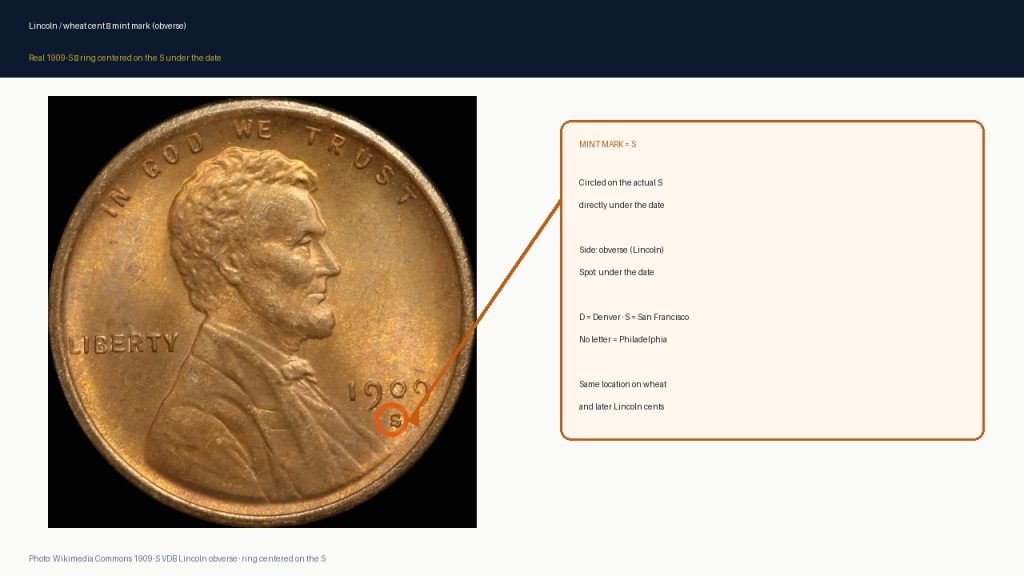
Always check under the date first
Full diagram set: where is the mint mark?. No letter under the date usually means Philadelphia. D = Denver. S = San Francisco.
Classic early Lincoln / wheat keys & semi-keys to pull
Set these aside if the date and mint match. Condition still decides whether they are “nice” or “rough but identifiable.”
- 1909-S VDB — famous key; VDB initials on reverse, San Francisco mint mark under date
- 1909-S — San Francisco without needing VDB drama; still a pull
- 1909 VDB (Philadelphia) — popular type; not the same animal as 1909-S VDB. Still worth verifying because people misread S marks
- 1914-D — Denver key; confirm the D carefully
- 1922 “Plain” (no D) — special case from Denver dies; needs careful attribution (not every weak-D is a plain)
- 1924-D — semi-key territory; pull and compare
- 1926-S — tougher S-mint; pull
- 1931-S — low-mintage S; always pull
Also pull (problems or special stories)
- 1943 copper (if you truly have copper color that is not plated steel) — famous error class; most “copper 1943s” are wrong. Steel 1943 is common history: steel cents
- Any cent with a clear, dramatic doubled die that matches a known variety reference — not random shelf doubling
- Off-metal or wrong-planchet suspects — leave them alone and show a pro
Usually bulk (even if “old”)
- Most 1940s–1950s Philadelphia, Denver, and San Francisco wheats in worn grades
- Steel 1943 cents in ordinary condition
- Memorial reverse cents (1959+) in circulation
Sorting workflow for a coffee can
- Dump onto a towel; work under good light
- Pull every 1909, 1914, 1922, 1924, 1926, 1931 first — then check mint marks
- Bag readable common wheats together for a bulk bid
- Do not clean, polish, or vinegar-soak anything you pulled as a key
- Get a counter look for the pull tray: CDXList
If an app prices every wheat at “up to” collector dream numbers, read why apps and Google lie. Rarity rules: old is not rare.
Common false alarms
- “S” dirt that is not an S mint mark
- 1909 without VDB and without S — common type coin for many grades
- Any Memorial cent “error” that is really plating damage on zinc
- Steel 1943 cents sold as copper after artificial toning or copper plating
When in doubt, set the piece aside and ask a dealer to look with you under a loupe. That five-minute conversation is worth more than an hour of conflicting videos.
Tools in this set
- Where is the mint mark? — locations by series with diagrams
- Wheat / early Lincoln cent key dates
- Buffalo nickel key dates
- Morgan dollar key dates
- Old is not rare — why mintage + condition matter