
← Back to articles · Hobby & visiting shops ·
Why the coin shop asked for your ID (cash, Form 8300, and not being a criminal)
They are not accusing you. Many shops have to know who they paid. Cash over $10,000 has a federal form. Splitting it to dodge the form is worse than filling it out.
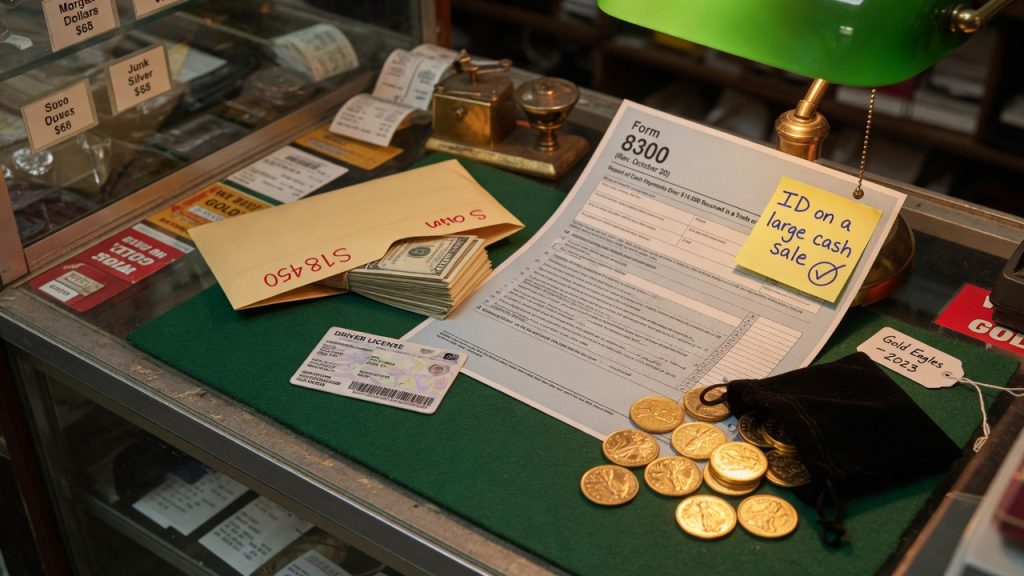
You walked in with something to sell. Maybe grandma’s jewelry. Maybe a couple gold eagles. The number was fine. Then they asked for a driver’s license and you felt like you were being booked for a crime you did not commit.
You were not. You also were not being singled out. This is one of those counter things the internet never explains, so people write a one-star review about “they treated me like a thief.” Let’s do the boring version, because the boring version is the truth.
This is not the shop inventing a rule so they can photocopy your face
A coin shop that buys gold and silver is a cash business that also buys secondhand metal. That combination is regulated. How much depends on the state, the license, and the size of the deal — but the pattern is the same almost everywhere:
- They have to know who they paid.
- They have to keep a record for a while.
- Some states treat precious-metal buying like a secondhand / pawn-adjacent trade. ID on the buy is not optional there. It is the license.
- If they pay you a lot of cash, there is a federal form in the mix.
None of that is a personal review of your character. The 78-year-old selling her late husband’s eagles fills out the same card as the guy who makes everyone nervous. That is the point.
The $10,000 cash thing — Form 8300, in English
If a shop pays you more than $10,000 in cash in one deal, or in related deals that are obviously the same pile of metal, federal law says they file IRS Form 8300. It is a report of a large cash transaction. Banks have their own version of this. Car dealers have it. It is not a coin-shop invention.
What it is not:
- It is not an accusation that you stole the gold.
- It is not automatically an income-tax bill. The form says cash moved. Your tax situation is a different conversation with your own accountant.
- It is not the shop “reporting you to the IRS so they can steal your money.” They are reporting a cash payment they made.
This is not legal advice. If you are doing a big cash sale, ask your own accountant how it sits next to your taxes. The shop is not your CPA, and they should not pretend to be.
Please do not “just make it $9,800” or come back tomorrow with the rest
That move has a name: structuring. Breaking one cash deal into pieces so nobody has to file the form is its own problem — worse than filling the form out. A decent shop will not play along. If they do play along, that is not a shop you want to be in.
If you do not want a cash report, there are grown-up options that are not a crime:
- Take a check or a bank wire instead of a stack of bills.
- Sell less, on purpose, because you only needed some cash this week.
- Sell the rest later because you actually decided to — not because you are dodging a form.
A shop that explains this calmly is doing you a favor. A shop that winks and says “we can do it in two tickets” is not your friend.
Why they still want ID on a $400 jewelry buy
Because stolen gold looks exactly like honest gold until it doesn’t. Secondhand metal laws exist because fencing is real. A shop that buys everything with a smile and no paperwork is a shop that will eventually buy something they should not have — and then the police are in the lobby and every customer from last month is in a report.
ID plus a short hold on some purchases is how a shop stays in business for twenty years instead of eighteen months. If that feels insulting, I get it. It still is not about you.
What a decent shop will do in front of you
- Tell you why they need the license, before they photocopy anything.
- Test and weigh in the open — not in a back room with the door shut.
- Write the offer down so the receipt matches the talk.
- Let you say no and take the metal home. It is still yours until you take the money.
If they get cagey when you ask what the paper is for, leave. If they treat the ID like a booking photo and a lecture, leave. You can want professionalism without wanting to be processed like a suspect.
What to write in the review later
Review whether they explained the paperwork. Review whether the check matched the bid. Review whether they were decent. Do not review them for following a cash rule you had never heard of. That review teaches the next customer the wrong lesson, and it teaches the next shop to hide the form until the last second — which is worse for everybody.
If the number itself felt low, that is a different article: why the offer was less than you expected. If you have not been in a shop before: what the first visit is actually like.
Part of the visitors & collectors library · NumisQ Learn