
← Back to articles · Hobby & visiting shops ·
Shield nickels: the first five-cent nickel, 1866–1883
Shield nickels (1866–1883) are copper-nickel, not silver. 1866–early 1867 have rays around the 5; later ones do not. 1877 and 1878 are the dates we treat as scarce. 1883 is the last year; then the V nickel.
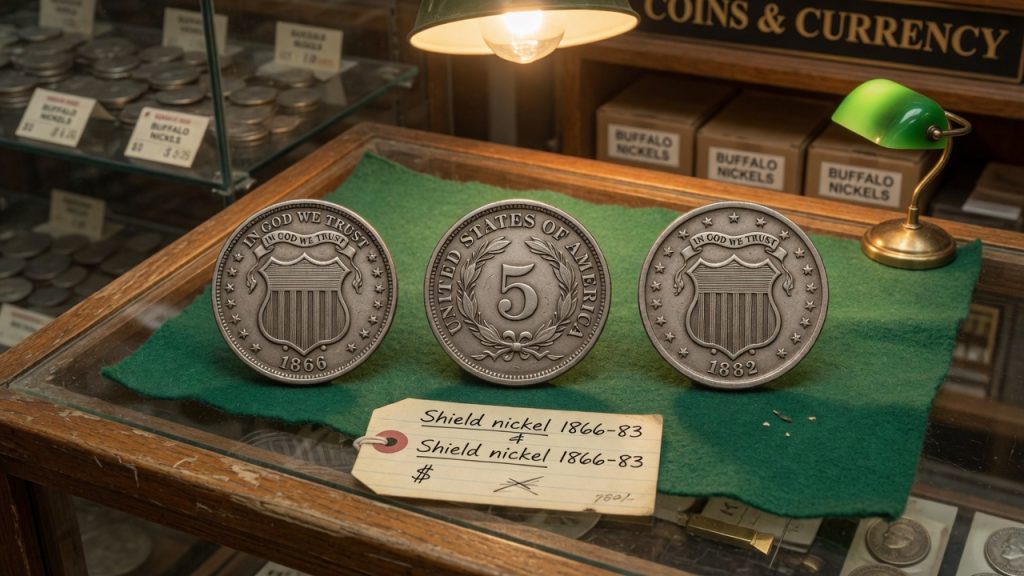
A Shield nickel is the first US five-cent piece made of copper-nickel, struck 1866 through 1883. James B. Longacre. Shield on the front. A big 5 on the back. There is no silver in it. Jefferson / war nickels are the silver five-cent story, and only for 1942–45.
Rays around the 5: 1866 and early 1867. The rays wore the dies, so they dropped them. Both 1867 types exist.
Common vs the ones we pull
Common 1867–1876 and 1882–1883 no-rays: a type bid. Dates we stop for: 1877, 1878 (low proof-era mintages), plus tougher 1879–1881. 1883 Shield is the last year, not a rarity by itself — the V nickel starts the same year (and the 1883 no-CENTS circus).
Extra history
The Shield nickel is Civil War leftover logic: silver was hiding, people needed five cents that was not a half dime or a two-cent. Copper-nickel was the answer. Same designer family as the Indian Head and the two-cent shield.
What a shop pays
Common worn: a few dollars as a type, not melt. Keys: we look them up. Dark, pitted, or holed: little. Don’t clean. Old is not rare.
Same jar as half dimes and V nickels: three different five-cent coins. Sort by the picture, not by “it says five cents.”
People also ask
Are Shield nickels silver? No.
Is 1866 automatically the rays type? Yes for circulation 1866. 1867 is the split year.
Is a Shield the same as a two-cent? No. Two-cent is bronze and says 2.