
← Back to articles · Hobby & visiting shops ·
How a coin die works
A die is the steel that stamps the picture. Two dies, a planchet, and a press. Wear on the die is how varieties start. Damage at the press is how errors start.
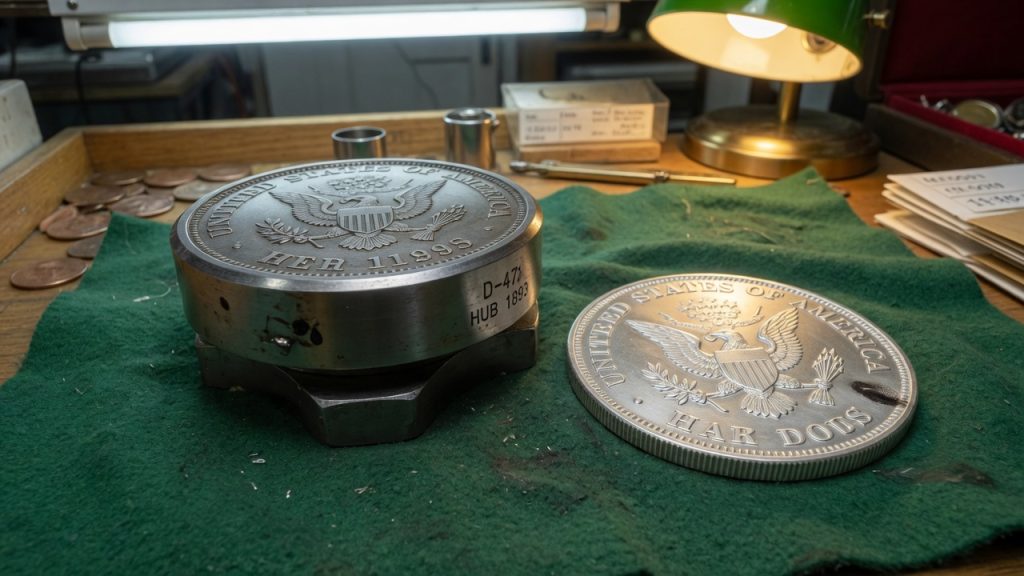
A die is the piece of steel that holds the design. The press slams it into a blank. That blank is a planchet. Two dies — obverse and reverse — make a coin. What a mint is.
The design is incuse on the die (sunk in) so it comes out raised on the coin. High points on the coin were the deep parts of the die. That is why hair and cheeks wear first. Sheldon.
Why this matters at a shop
When a die cracks, clashes, or is hubbed twice, every coin from that die can share the same mark. That is a die variety. It is on the die. It repeats.
When a planchet is wrong, or grease fills a letter, or the strike is off-center, that is usually a mint error. It happened to that one coin, or that one moment at the press. Errors vs varieties. Error hype.
What people mix up
Ridges on the edge are a collar, not a die face. Why coins have ridges. A worn die can make a “soft” coin that is still Mint State. Soft is not wear. Mint State.
A shop looks at the coin, not the YouTube of the press. If the mark is in the book and on the date, we talk variety. If it is a one-off ding from 1974, we talk damage or a cheap error.
Continue in the coin and money library. Related visitor guides: for shop visitors.