← Back to articles · Hobby & visiting shops ·
Melt value before you visit a shop
Melt is the metal in the coin at today’s spot — not a shop bid. How to sort by year, skip gold-colored dollars that are not gold, and use Melt Prices at the kitchen table before you walk in.
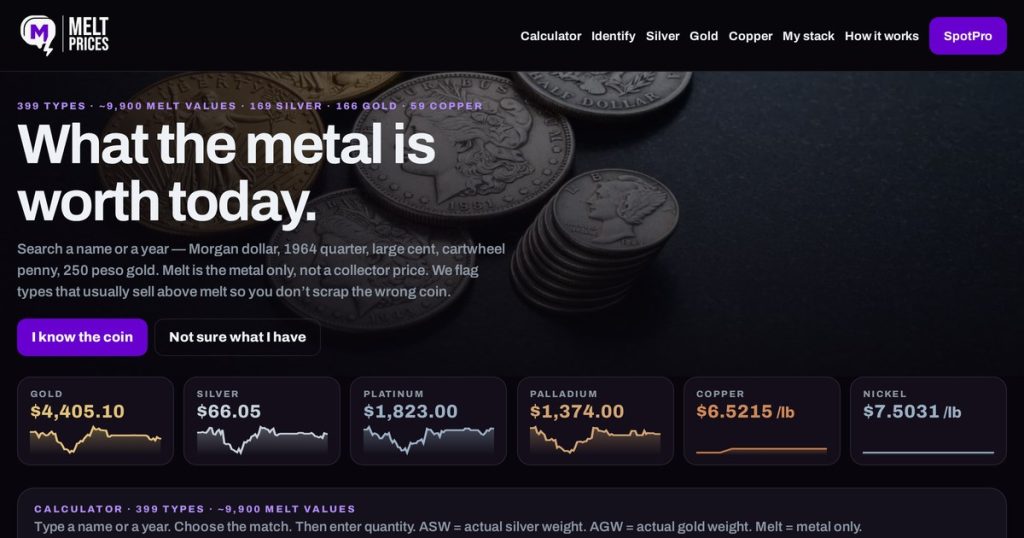
Before you walk into a shop with a coffee can, you can answer one honest question at the kitchen table: how much metal is in these coins? That number is melt. It is not a shop bid, not a Red Book line, and not what a YouTube thumbnail said the coin is “worth.”
Melt is the metal, not the coin
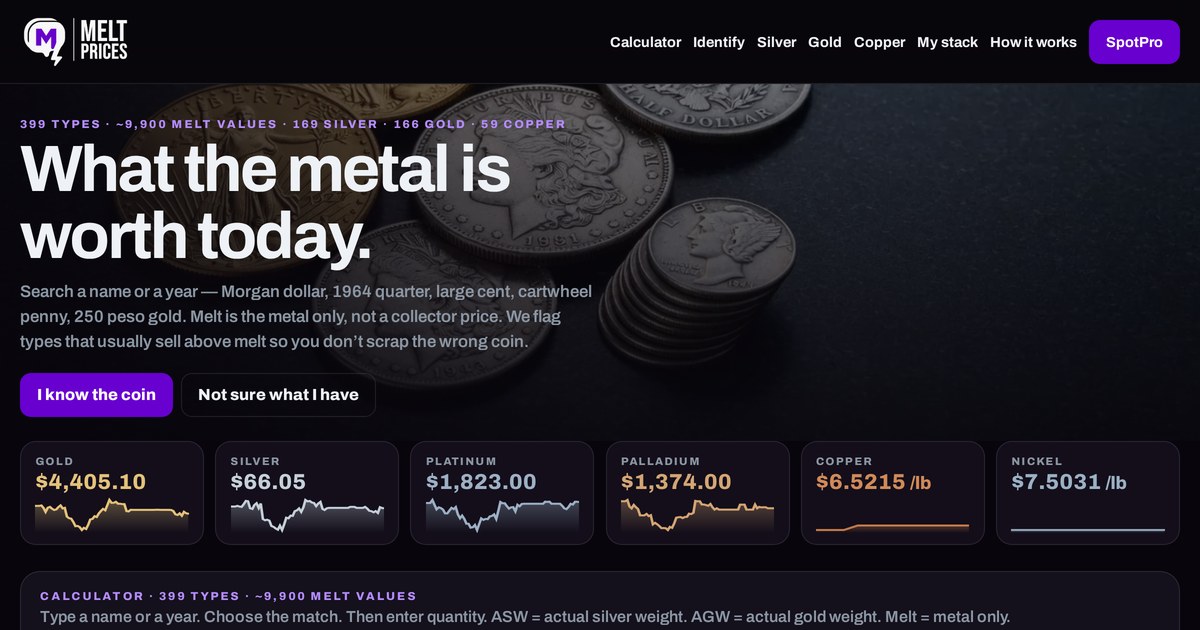
Melt is weight × fineness × today’s spot. A worn 1964 Washington quarter has a known amount of silver. So does a common Morgan dollar. The date on a Morgan does not change the ounces — 1878 and 1921 are the same spec. (Morgans were not struck in 1920. The years are 1878–1904 and 1921.)
A shop may pay a percent of that melt on generic metal, or more than melt on a date collectors actually want. That is why two numbers exist. Melt is the floor. The offer is a business bid. Related: pricing at a shop and why the offer felt low.
The year on the coin decides the metal
The portrait is not enough. A Washington quarter from 1964 is 90% silver. The same design from 1965 is clad — a copper stripe in the edge, almost no silver. Kennedy halves change three times: 1964 is 90%, 1965–1970 is 40%, 1971-on business strikes are clad. War nickels (1942–1945 with the large reverse mintmark) are 35% silver; a 1946 nickel is not. 1982 cents exist in both copper and zinc — weigh them (~3.1 g vs ~2.5 g).
We keep the 90% / 40% / war-nickel map here: junk silver in English. Melt Prices has a page for each of those year splits so you can search “1964 quarter” or “1965 quarter” and get today’s dollars, not a lecture.
Gold-colored is usually not gold
Presidential, Sacagawea, Native American, and Innovation dollars are manganese brass over a copper core — about 8 grams. They look gold. They are not gold. Melt is a few cents of copper and nickel. A real 1 oz Gold Buffalo or Gold Eagle weighs about 31 grams and is marked with the ounce weight and fineness. Gold-plated Ike dollars and novelty “$50 Buffalos” from TV ads are a thin wash, not bullion.
Tiny old US gold dollars (1849–1889) are gold — and they are eraser-head small, not a Sacagawea. See tiny gold and 10k/14k novelties.
How to use Melt Prices without fooling yourself
- Open meltprices.com. Search the name or the year you have — “1964 quarter,” “Morgan dollar,” “war nickel.”
- If you do not know the series, use Identify: denomination, then year, then “does it look gold?”
- An inherited coffee can: I inherited a box — sort piles, skip gold-colored dollars, add what you already know.
- Enter a quantity. For worn 90% dimes, quarters, halves, and dollars you can use $ face — $1.00 face is commonly 0.715 oz silver because bags are worn.
- The percent slider (starts at 70%) is a sanity check for generic metal. It is not that shop’s bid.
Melt Prices lists hundreds of types and melt for the dated years those types cover. A 1934 quarter and a 1936 quarter both have a melt — they are the same 90% Washington spec. Date and mintmark do not change the ounces. They can change whether a collector will pay more than melt. Pull lists (no prices): Morgan keys, wheat keys, Buffalo keys.
Then a shop — not a website quote
After you have a melt number, Melt Prices can look up shops near a ZIP from CDXList. That is a directory, not a lead form and not an offer from Melt Prices. Call first. Hours and what they buy vary.
A decent shop will still look at the dates you pulled, weigh the gold-looking dollars, and tell you if something is a collector piece. That is the job. Melt Prices does not grade coins, does not invent a collector range, and does not photograph the box. Kitchen-table sort: knowing what you have before you walk in.
What this is not
- Not a Red Book cash bid. The Red Book is not a dealer buy list.
- Not an app “worth” number. Why coin-value apps and Google “worth” searches lie.
- Not a promise the shop will pay 100% of melt. Spreads keep the lights on.
Tool: meltprices.com · Identify: meltprices.com/identify · Inherited box: meltprices.com/inherited. Find a shop: NumisQ Shops or CDXList.
Part of NumisQ Learn · visitors & collectors · NumisQ.com/learn