
← Back to articles · Hobby & visiting shops ·
The Sheldon scale: what AG-3 through MS-70 actually means
Dr. William Sheldon’s 1–70 scale is the language of US coin grades. Wear, not shine. Why G-4 is not “a four,” why AU-58 is not MS, and why a shop still looks at the coin.
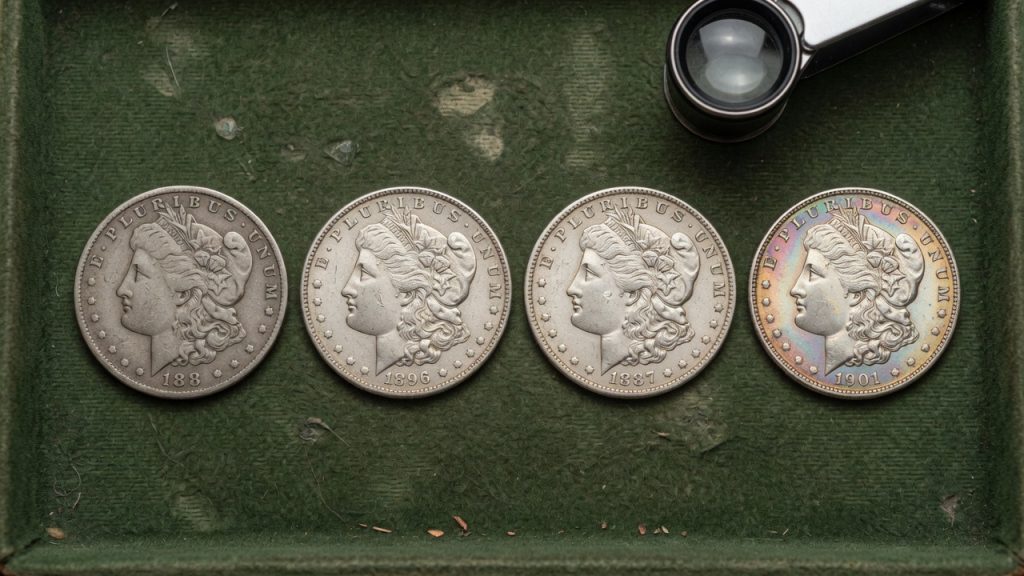
The number on a slab is not a price. It is a claim about how much of the original design is left, and how clean the remaining surface is.
That number comes from the Sheldon scale: 1 to 70. Dr. William Sheldon published it in 1949 for large cents. The American Numismatic Association and the big grading services adapted it for the whole hobby. PCGS vs NGC. When to slab.
The photos on this page are teaching photos of wear, not official ANA or PCGS plate coins and not a promise that a given date looks like that. Look at the coin in your hand. Don’t clean it.
What the scale is measuring
Through About Uncirculated, the number is mostly wear. High points flatten. Letters soften. The date dies last, then it goes.
From Mint State 60 to 70, there is no wear. The fight is marks, strike, luster, and eye appeal. A scuffy MS-61 and a clean MS-65 can be the same date. They are not the same coin.
A shop still looks. Plastic can be fake. A raw coin can be honest. Details / cleaned / scratched.
The circulated numbers people actually say
- PO-1 Poor. A disc you can sometimes date.
- FR-2 Fair. Outline. Date maybe.
- AG-3 About Good. Date readable with work. Rims gone into the letters.
- G-4 / G-6 Good. Full rims. Major devices outlined. Hair and feathers almost gone.
- VG-8 / VG-10 Very Good. Some inner detail. LIBERTY often partial.
- F-12 / F-15 Fine. About half the design detail. LIBERTY usually full on coins that have it.
- VF-20 to VF-35 Very Fine. Most design there. High points worn, not gone.
- XF-40 / XF-45 Extremely Fine (EF). Light wear on the highest points only. Some luster can hide in the letters.
- AU-50 to AU-58 About Uncirculated. Friction on the cheek, knee, or breast. AU-58 can fool a phone camera. It is not Mint State.
Mercury dimes in a row are a good way to see this with your own eyes: left is tired, right still has bands. Mercury dimes. Mercury keys.
Mint State, in one breath
- MS-60 to MS-62 Uncirculated and ugly. Bag marks. Dull luster. Still no wear.
- MS-63 / MS-64 The common “nice uncirculated” people mean.
- MS-65 / MS-66 Scarce on many 19th-century types. Common on some modern bullion.
- MS-67 and up Registry language. Not a junk-silver conversation.
- MS-70 Perfect under magnification as the service defines perfect. Modern coins, mostly.
Mint State MS-60 to MS-70. Circulated grades.
What a shop does with the number
A common date in XF or AU is often still a 90% silver bid, or a small type premium. A key date in G-4 can be real money. Old is not rare. Greysheet for regular people.
We do not pay “MS-65 eBay sold” on a raw coin in a sandwich bag. We pay the coin.
Market grade vs technical grade
Technical is wear and marks. Market is what the room will call it this year. A pretty AU-58 sometimes sells like a low Mint State. A dull MS-64 does not. That is why two slabs of the same number can bring different money.
Plus, star, CAC, details
Plus and star are house adjectives on top of the number. CAC is a second opinion on a coin people already care about. Details means genuine, but cleaned, scratched, tooled, or damaged — not a straight number. Details grades.
What to read next
How to look at a coin with a loupe. Proof vs uncirculated vs bullion. Red Book is not a buy list.
Continue in the coin and money library. Related visitor guides: for shop visitors.