
← Back to articles · Hobby & visiting shops ·
Large cents: the penny that is bigger than a half dollar
US large cents (1793–1857) are copper coins the size of a half dollar. Later Coronet and Braided Hair dates are common in worn grades. 1793 Chain and Wreath cents are not. A 1851 large cent is not automatically rare because it is old and brown.
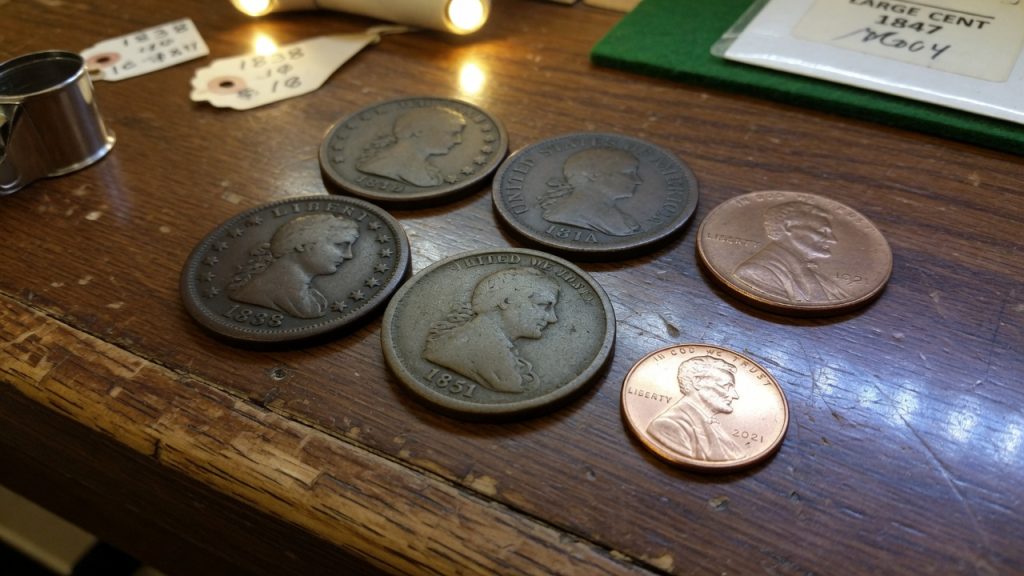
A large cent is the US one-cent piece struck 1793 through 1857. It is pure copper (more or less) and about the size of a modern half dollar. A Lincoln next to it looks like a toy.
Types, in order: Chain (1793), Wreath (1793), Liberty Cap, Draped Bust, Classic Head, Coronet (Matron Head), Braided Hair. Half cents (1793–1857) are the little sibling in the same drawer. Early copper. Early federal coinage.
Common vs the ones we pull
A worn 1840s–1856 Braided Hair large cent is old copper, not a key. We see them every week. 1793 Chain and Wreath, 1799, 1804, and a few other early dates are the ones that change the bid. Condition on early copper is its own language (porosity, corrosion, scratches). A pretty brown 1853 is still a common date.
1857 is the last year. Then the Flying Eagle small cent, then the Indian Head.
Extra history
Large cents were everyday money when a cent still bought something. They were also heavy. The Mint shrank the cent in 1857 because copper was costing too much and people were tired of the slab. Half cents died the same year.
What a shop pays
Common later dates: a modest copper-collector bid, more if the surfaces are original. Eaten-up or harshly cleaned: little. Early dates: we look them up, and we are honest about porosity. Don’t clean. Never dip a large cent in acid to “bring the date back.”
Half cents in the same box follow the same rule: late-date Braided Hair half cents are type coins, not keys. 1793 half cents are not. If someone ground the edge or plugged a hole, say so before we weigh the story.
A “large penny from England” is usually a British penny, not a US large cent. Look for UNITED STATES OF AMERICA.
People also ask
Is every large cent rare? No. Old is not rare.
Is a 1851 large cent a key? No. High mintage, common in worn grades.
Are they silver? No. Copper. No melt story worth the argument.
Continue in the coin and money library. Related visitor guides: for shop visitors.