
← Back to articles · Hobby & visiting shops ·
So-called dollars: dollar-sized medals, not dollars
So-called dollars are US commemorative medals about the size of a silver dollar, catalogued by Hibler and Kappen (HK numbers). They are not legal tender. A Columbian expo medal is not a Columbian half dollar. Silver ones we weigh; rare HK numbers we look up.
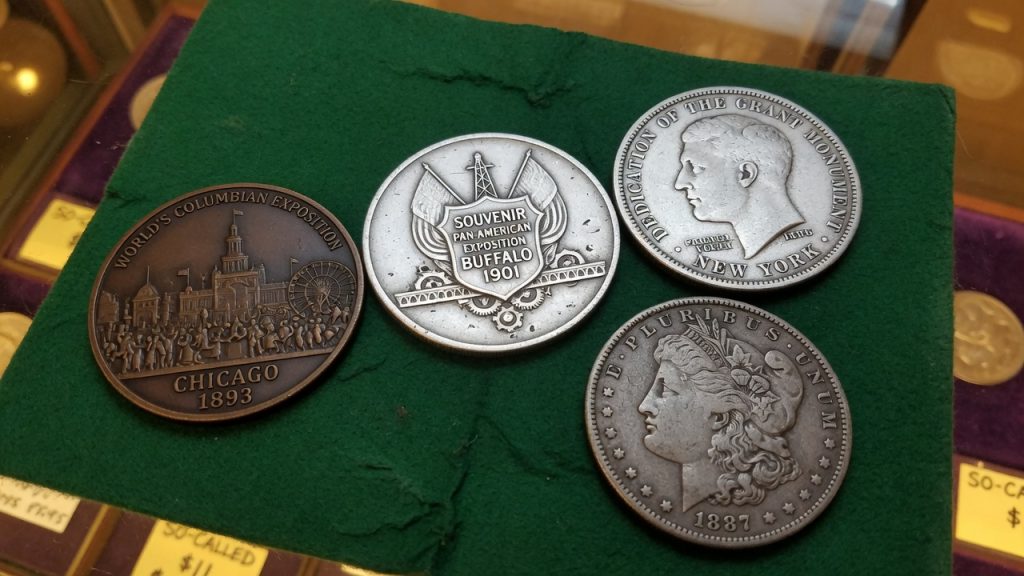
A so-called dollar is a medal, about the size of a silver dollar, struck for a US fair, a canal, an inauguration, a mining camp, or the silver fight. Collectors named them that because they look like a dollar and are not one.
The standard book is Hibler and Kappen, So-Called Dollars (1963, later reprint). Pieces get HK numbers. If someone says “HK-155,” they are in that catalog. Medal vs coin. What a dollar is.
New York dealer Thomas Elder used the phrase in a 1912 catalog. The name stuck.
What counts (and what does not)
Hibler and Kappen wanted pieces that are:
- about 33–45 mm (Bryan “dollars” can run larger)
- struck in or for the United States
- about a public event, a fair, or a money/silver theme
They generally left out military medals, church medals, award medals, lodge pieces, and ordinary store cards. A PX token is not an HK. Canal Zone tokens. A Franklin Mint sterling souvenir from 1976 is usually not in that book either — later private mint, different hobby.
The US Mint struck some of these. Private shops struck most of them. Bronze, brass, white metal, aluminum, gilt, and silver all exist for the same design.
The ones that walk in
World’s Fair and expo medals — Columbian 1893, Pan-American (Buffalo 1901), St. Louis 1904, Panama-Pacific, later fairs. Common bronze and white-metal souvenirs are modest. Silver versions we weigh, then see if the HK number is one people chase.
Bryan dollars — political pieces from the 16-to-1 silver campaigns. Bigger than a Morgan, often. Collected as so-called dollars.
Lesher Referendum dollars (Victor, Colorado, 1900–1901) — Joseph Lesher’s silver pieces, often numbered, meant to circulate locally. Still filed with so-called dollars. These can be real money in the collector sense. Do not toss one in the sterling pile.
Pedley-Ryan, Nevada “dollars,” mining souvenirs — silver or silver-ish, local. We test. Fineness.
Not the same as a commemorative half
The 1892–93 Columbian half dollar is a US coin. HALF DOLLAR is on it. Commemorative halves. A Columbian expo medal the size of a dollar is a so-called dollar. Same fair, different object, different bid.
A Morgan is a dollar. The medal next to it in the photo is not.
What a shop pays
- Common bronze / white metal expo pieces: a collector token bid, often small
- Silver: weight first, then HK if we know it
- Lesher, scarce Bryan, rare expo silver: look up, do not melt
- Holed, looped, or harshly cleaned: less. Don’t clean
We will put it next to a Morgan to check the size, read the event, and say whether it is a coin, an HK medal, or a later souvenir. World’s Fair paper and tokens are a different drawer.
People also ask
Are so-called dollars legal tender? No.
Why “so-called”? Because they are called dollars and are not.
Is every dollar-sized medal an HK? No. Size is only one test. Event and origin matter.
Should I slab one? Only if it is a scarce HK in superb metal. When to slab.
Continue in the coin and money library. Related visitor guides: for shop visitors.