
← Back to articles · Hobby & visiting shops ·
Military payment certificates: base money, C-day, and what a shop actually buys
MPCs paid US troops overseas from 1946 to 1973 so greenbacks would not flood the local black market. On conversion day the old series died. They are not US legal tender. Common circulated notes are collector paper, not a hidden stash of dollars.
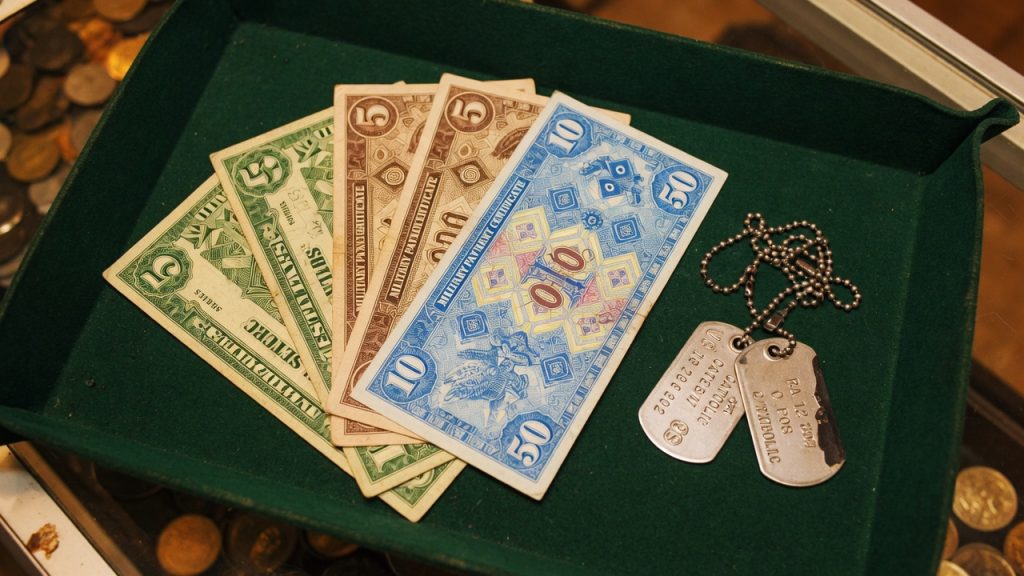
An MPC is Military Payment Certificate. It is what the US military paid troops with on overseas bases from 1946 to 1973 so American greenbacks would not pour into the local black market.
You could spend it at the PX. You could not legally hold dollars in your footlocker. On conversion day (C-day) they swapped the series with no warning. After that, the old notes were void for spending. That is the whole trick. Emergency money is the cousin (Hawaii, yellow seal, Civil War). This is the later, organized version.
The series
Thirteen series were issued. The number is the series, not a year on the face: 461, 471, 472, 481, 521, 541, 591, 611, 641, 651, 661, 681, 692. Series 691 and 701 were printed and not issued. The last circulating series, 692, was Vietnam and ended in 1973.
Denominations ran 5¢ up through $1, $5, $10, and later $20. The notes are colorful on purpose — hard to confuse with a Federal Reserve note at a glance.
What they are not
They are not US legal tender. You cannot spend one at a grocery store. Legal tender. They are not a silver certificate. They are not a Hawaii overprint. A Vietnam-era $10 MPC is not ten spendable dollars.
What a shop pays
Common circulated 5¢–50¢ notes from later series are collector paper. Low dollars unless the grade is superb, the serial is fancy, or it is a replacement. Replacements and early series in high grade are the ones that jump.
A shorted stack from a footlocker is usually a bulk paper bid plus a few better notes if they are there. We will sort. We will not pay face “because the Army printed it.” Why apps lie. World coins if the same box has yen and pfennigs.
Do not laminate them. Do not iron them. Bring them flat in a sleeve. What to bring.
Part of the coin and money library · visitors & collectors
Reproductions and look-alikes
Pretty color copies exist. So do Allied Military Currency, Japanese invasion money, and occupation notes. Those are different paper from a different war or a different issuer. If the box is mixed, make three piles: MPC, other military/occupation paper, and ordinary foreign. Emergency money. World coins.
A footlocker stack that looks like play money is often MPCs. Do not throw it out. Sleeve it. We will read the series number.
WWII occupation paper is Allied Military Currency or Japanese invasion money, not an MPC. Canal Zone tokens are metal chits, not notes.