
← Back to articles · Hobby & visiting shops ·
Tiny gold coins, use gold, and 10k/14k novelties: what you actually have
Eraser-head “gold coins,” charm medallions, and 10k/14k jewelry look like treasure. Most are use gold or tiny melt — not rare investment bullion. How to tell what you are holding.
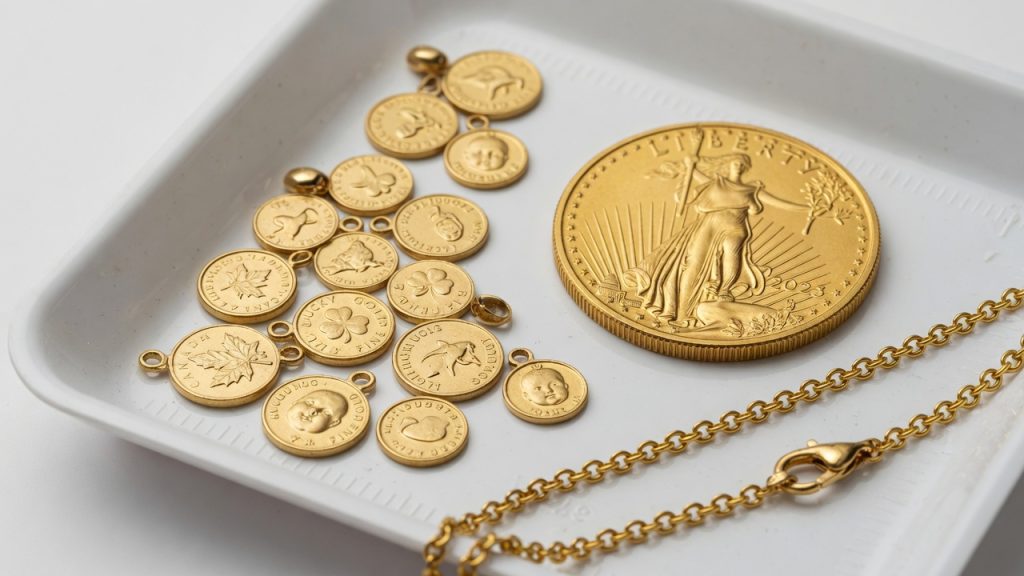
Someone hands you a tiny gold disc the size of a pencil eraser tip. It has a maple leaf, a baby face, a dolphin, a “lucky” slogan, or a year stamped on it. It shines. It feels heavy for its size. Online, similar pieces list for eye-watering prices. A video says “solid gold coin found in estate — worth a fortune.”
Most of the time, you are looking at use gold or a novelty / charm — real gold alloy, real melt value measured in fractions of a gram — not a rare numismatic coin and not an investment bullion round like a full-size American Gold Eagle or Maple Leaf.
This article is the field guide for that exact confusion.
What “use gold” means
Use gold is gold made for wearing or decorating, not for stacking as investment metal. Think:
- Rings, chains, charms, earrings, class rings, dental gold (sometimes)
- Thin “coin” pendants and religious medals
- Costume-style medallions that happen to be 10k or 14k rather than plated base metal
- Tiny birth / baby / lucky charms sold at jewelers and gift shops for decades
Use gold is still gold. Shops buy it. The bid is almost always weight × purity × spot × the shop’s pay percentage — jewelry melt rules — not “collector coin” rules. Marks like 10K, 14K, 18K, 585, 750, or a karat stamp matter more than the cute design.
Why size destroys the fantasy
A full-size 1 oz American Gold Eagle holds about one troy ounce of pure gold (with a little alloy for durability on the U.S. eagle family). A charm the diameter of an eraser head might hold a few tenths of a gram of pure gold if it is solid 14k — sometimes less if it is hollow or has a heavy bail.
At modern gold prices, that can still be “some money.” It is almost never “the rare gold piece the video implied.” Weight is ruthless. If it sits on a scale and barely moves the third decimal, the story ends at melt math.
If it is the size of a pencil eraser tip, it is not a full bullion coin hiding in disguise. It is a miniature. Treat it like jewelry until a professional proves otherwise.
10k vs 14k vs 18k vs “fine” bullion
Purity is not a vibe. It is a fraction:
- 10k — about 41.7% gold. Common in U.S. jewelry. Durable, lower gold content.
- 14k — about 58.3% gold. Extremely common for chains, charms, and “coin” pendants.
- 18k — about 75% gold. Higher jewelry grade; still use gold unless it is a recognized bullion product.
- 22k / 24k bullion coins and bars — investment products with known weights and brands (Eagles, Maples, Buffalos, bars with hallmarks). These trade on bullion markets with premiums, not only as scrap.
A 14k charm can be 100% real gold alloy and still be mostly copper and other metals by weight. “It tested gold” does not mean “it is a one-ounce investment coin.”
Common look-alikes that fool people
- Miniature “Maple,” “Eagle,” or “Krugerrand” style charms — sold as jewelry for decades. Often 14k. Sometimes not even gold (plated). Bail or jump ring is a giveaway that it was meant to hang, not to stack.
- Baby / baptism / “lucky penny” gold discs — sentimental gifts. Melt when sold.
- Hollow or filled pieces — look thick, weigh little. Shops check this constantly.
- Gold-plated base metal — yellow color only. Acid tests and XRF separate these from karat gold.
- Token / casino / souvenir “coins” — brass or bronze that look “old gold” under warm light.
- Real but tiny fractional bullion — 1 gram bars or very small recognized rounds exist. They still sell near small-bar melt/premium rules, not “rare artifact” rules. Packaging and hallmark matter.
How shops will treat these (and why that is fair)
At the counter, expect:
- Test for karat or plating
- Weigh (and note if hollow)
- Pay scrap/use-gold percentage of melt — not numismatic retail
- Little or no premium for “cute design” unless a specialty collector market exists (rare)
That is not the shop “not recognizing your rare coin.” That is the shop recognizing jewelry. If you bought it at a mall jeweler for $120 in 1998, the gold content may only support a fraction of that today — or more, if spot ran hard — but the path is still melt math.
Quick home checks (before you drive)
- Look for stamps: 10K, 14K, 18K, 585, 750, GP/GEP (plated), or nothing at all.
- Look for a bail, loop, or solder scar — jewelry, not circulation coinage.
- Compare to a real bullion coin if you have one — diameter and thickness are obvious teachers.
- Weigh on a decent gram scale — write the number down. Bring the scale photo if you want; shops will re-weigh.
- Do not scratch, drill, or acid-test at home if you care about resale appearance. Let the shop test.
When it might be more than scrap
Occasionally a small gold piece is a recognized fractional bullion product, an older coin that was made into jewelry (loop soldered on a real gold dollar, for example), or a specialty item a collector wants. Signs that deserve a second look:
- Clear government mint marks and known bullion series with documented weight
- Original assay packaging for small bars
- A real historic gold coin that was mounted (value may still be hurt by the mount)
Even then, mounting and soldering often reduce collector value. Honest shops will say so.
How this ties to online fantasy prices
Etsy and social listings love tiny gold because it photographs like treasure. Creators love it because “solid gold coin” sounds better than “0.4 grams of 14k charm.” Search engines surface the drama. Your kitchen table still has to face a scale.
Pair this guide with why coin apps and Google “worth” searches lie and troy ounces, purity, and melt value.
What to do next
- Sort obvious jewelry and tiny charms into a “melt” bag
- Keep real-size bullion and recognizable coins separate
- Get a same-day bid from a local dealer — start with CDXList.com
- If an estate is large, ask for a quiet appointment so staff can test properly
Yellow and small does not mean rare. Karat stamps and weight tell the truth faster than any thumbnail.
More for heirs and first-time sellers: knowing what you have before you walk in, estates and inherited metal, and physical gold and silver basics.