
← Back to articles · Hobby & visiting shops ·
Emergency money: Civil War tokens, fractional notes, Hawaii and North Africa
When coins vanished or an invasion looked possible, Americans used stand-ins: Civil War store tokens, fractional paper, HAWAII-overprint dollars, and yellow-seal North Africa notes. Most are collectible paper and copper, not a second paycheck.
Emergency money is what a country uses when the usual coins and notes are the wrong tool.
In the United States that usually means the Civil War and World War II. The pieces look dramatic. Most of what walks into a shop is common enough to have a collector bid, not a fantasy bid. What a banknote is. What legal tender means.
Civil War tokens (1862–1864)
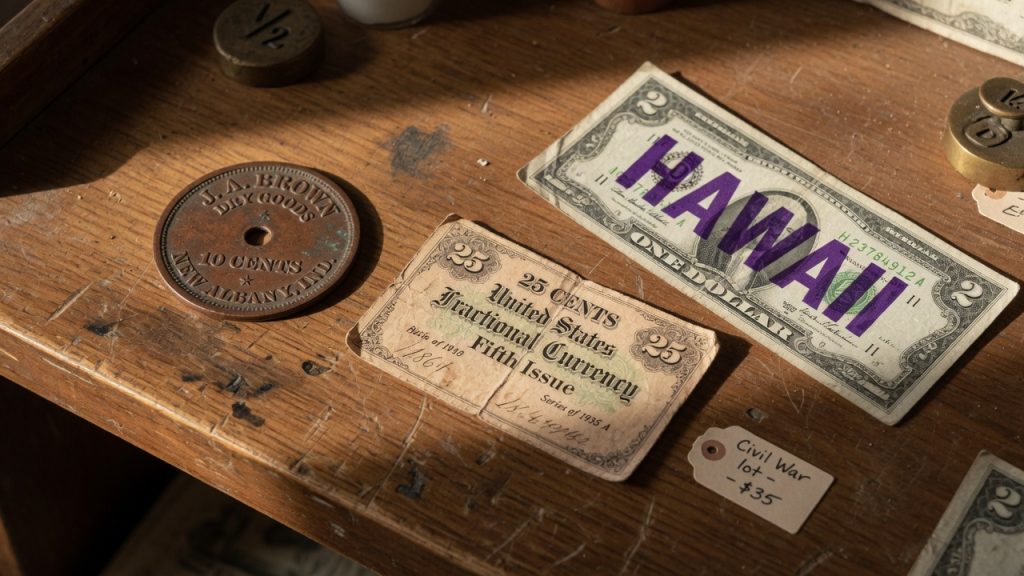
Small change was hoarded. Merchants issued copper tokens the size of a cent — store cards with a name and city, or patriotic pieces with flags and slogans. They were not federal coins. They spent like cents until the government told them to stop.
A common patriotic token or a common store card is a few dollars to a modest collector number. A rare merchant, a rare die, a silver or German-silver piece is different. Do not clean them. Don’t clean.
Related: encased postage (a stamp in a brass frame) and fractional currency — paper 3¢, 5¢, 10¢, 15¢, 25¢, 50¢ issued 1862–1876 because there were not enough coins. Worn fifth-issue 25¢ and 50¢ notes are the ones people find in Bibles.
Hawaii overprint notes (1942–1944)
After Pearl Harbor, military authorities in the Territory of Hawaii recalled ordinary dollars and issued notes with HAWAII in brown at both ends of the face and in huge letters on the back, with brown seals. If Japan had taken the islands, those notes could be declared void.
Issued in $1 silver certificates and $5, $10, $20 Federal Reserve notes. Used into 1944. A circulated $1 HAWAII is a collected emergency note. Uncirculated and high denominations cost more. It is still a dollar of spending money plus history, not a second mortgage.
North Africa yellow seal
Silver certificates with a yellow seal (instead of blue) went with US forces in North Africa and later Italy. Same idea: if stocks of notes were captured, the Treasury could demonetize that seal. $1, $5, $10. No giant overprint. People mix them up with Hawaii notes. Hawaii is brown and says HAWAII. North Africa is a yellow seal.
Military paper that is not these
Military payment certificates are a later, separate system (1946–1973) for bases overseas. Do not call an MPC a Hawaii note.
What to do
Do not iron the paper. Do not tape it. Bring the token dirty. World coins if the drawer is mixed. Silver certificates if it is a blue-seal dollar with no overprint — that one is still a dollar.
Continue in the coin and money library. Related visitor guides: for shop visitors.
Occupation lire, marks, and yen are Allied Military Currency. Banana pesos are Japanese invasion money.
Kingdom silver is a different Hawaii: 1883 Kalakaua coins.
Southern paper is its own pile: Confederate notes. Obsolete / broken-bank notes.