
← Back to articles · Hobby & visiting shops ·
Three-cent pieces: the tiny silver trime and the nickel three-cent
The US made two three-cent coins. The silver three-cent (1851–1873) is tiny. The nickel three-cent (1865–1889) is larger and copper-nickel. Neither is a dime. Common early silver dates are type coins; later proof-only years are not a coffee-can find.
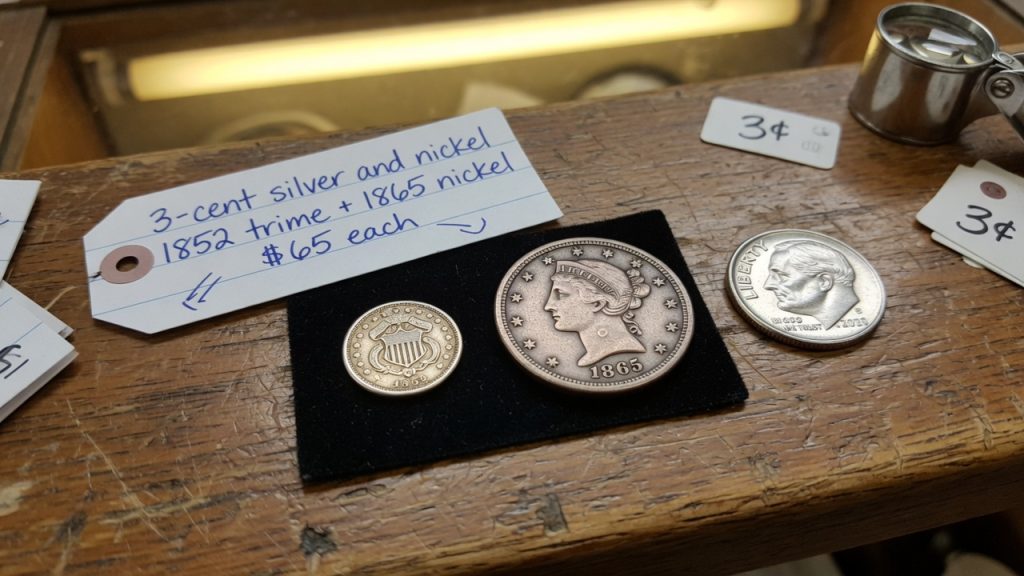
The US made two three-cent coins. People mix them up with dimes and with two-cent pieces.
Silver three-cent (trime), 1851–1873: a tiny star-and-shield silver coin. Type 1 (1851–53) is plainer; Type 2 and 3 add outlines on the star. 1851-O is the only branch-mint silver three-cent.
Nickel three-cent, 1865–1889: larger, copper-nickel, Liberty with a coronet. Civil War change, like the Shield nickel.
Common vs the ones we pull
Early silver (1851–1853) and common nickel dates (1865–1868): type bids. Late silver dates and 1870s–80s nickel dates get scarcer; some are proof-only. A holed trime is a remnant, not a key.
Extra history
The silver three-cent was meant for 3-cent postage. It is one of the smallest US coins. The nickel three-cent is the same impulse as the two-cent: get small change back into drawers after the war.
What a shop pays
Common type: a small collector bid. Tiny silver we still treat as a coin, not melt — there is almost no silver in one trime. Don’t clean.
People also ask
Is the little silver one a half dime? No. Half dimes say HALF DIME and look like tiny Seated dimes.
Are nickel three-cents silver? No.
Why three cents? Postage, and a gap between the cent and the half dime.
More on the coin and money library.
The silver trime is easy to lose in a dime pile. It is smaller than a dime and thinner. If you dump a bag into a sorter, check the corners of the tray.
Nickel three-cents get mixed with V nickels. The three-cent is smaller and says THREE CENTS or shows a Roman III, not a V.
A bent trime is still a trime. We do not straighten it.
The other tiny silver five-cent-era coin is the half dime.